Written By: Undefeated Healthcare Editorial Team
Reviewed By: Chase Butala MS LPC, LCPC
You didn’t “run out of time.”
You didn’t “get distracted.”

You didn’t “just need more discipline.”
You made a decision. Quietly. Automatically. And your brain chose comfort over consequence.
That’s the part nobody wants to admit.
Because if procrastination was just laziness, it would be easy to fix. But it isn’t laziness. It’s neuroscience. And it’s running your calendar, your relationships, your finances, and your self-respect more than you think.
So the real question is not “Why do I keep procrastinating?”
It’s: “What is my brain trying to protect me from?”
And more importantly: “At what cost?”
Procrastination is the brain’s tendency to delay tasks that feel emotionally uncomfortable, even when we know those tasks matter.
That’s it. No moral failure. No personality flaw.
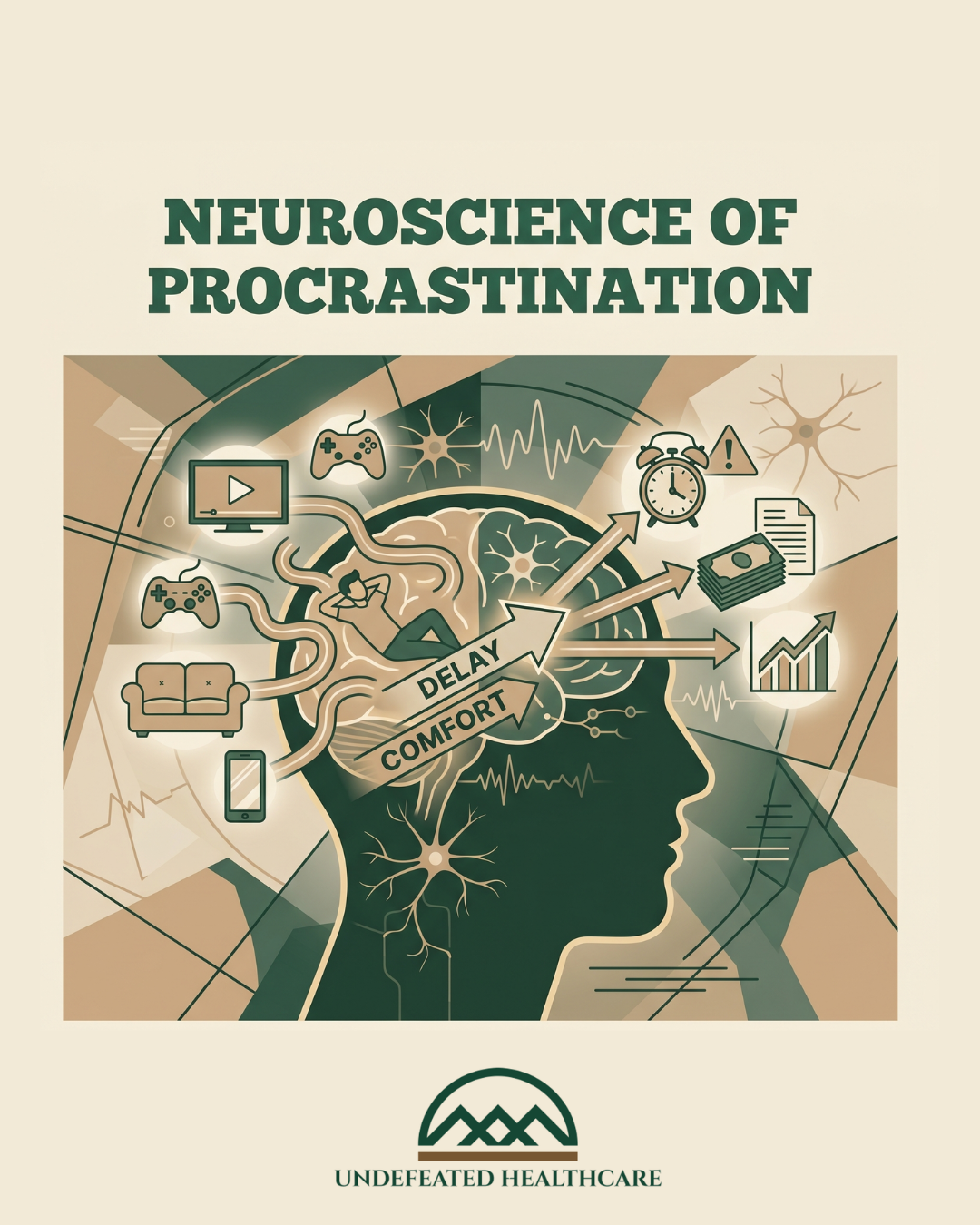
A 2021 review in Frontiers in Psychology described procrastination as an emotion regulation problem, not a time management problem. When stress rises, the brain shifts away from long-term thinking (prefrontal cortex) and toward short-term relief (limbic system).
Translation: Your brain picks “feel better now” over “win later.”
That email you keep avoiding? That conversation you keep postponing? That workout plan you restart every Monday?
Your brain tags them as emotional threats, not tasks.
And it moves you away from discomfort like it would move you away from danger.
When you face something stressful or unclear:
The amygdala activates (threat response)
Dopamine systems push toward easier rewards
The prefrontal cortex, responsible for planning and impulse control, gets overruled
So instead of doing the hard thing, you:
“Research” for 45 minutes
Suddenly become interested in reorganizing your life at 11:47 PM
As the comedian Jim Gaffigan jokes:
Continue reading the full field note
“I love deadlines. I like the whooshing sound they make as they fly by.”
Funny. Because it’s accurate.
A man in his 30s in Bethesda keeps delaying a promotion application. He’s qualified. Overqualified. But every time he opens the document, he feels a tightening in his chest and closes it.
He tells himself: “I’ll do it when I have more time.”
But “more time” never feels emotionally safer.
A mother in Martinsburg knows she needs to set boundaries with her partner. Every time the moment comes, she backs off, not because she doesn’t care, but because conflict feels like emotional risk.
So she scrolls. Numbs. Waits.
Two partners keep postponing the same conversation about finances. Not because they don’t know what to do, but because they don’t want to feel misunderstood, judged, or out of control.
So nothing changes. Just tension.
Procrastination is not rare. It’s normal.
Research consistently shows:
Around 20% of adults are chronic procrastinators (Steel, 2007; still widely cited in updated reviews)
A 2021 study in Personality and Individual Differences found strong links between procrastination and:
The American Psychological Association continues to highlight avoidance behavior as a key driver of chronic stress and burnout patterns (APA, 2023)
And it shows up everywhere:
Work: missed deadlines, performance anxiety, hidden burnout
Home: unresolved conversations, emotional distance
Relationships: avoidance of conflict, intimacy issues
Health: delayed appointments, inconsistent habits
Men often experience procrastination as internalized pressure: “I should be able to handle this.” So they delay until urgency forces action.
Women often experience it through emotional overload: “I need the right time, the right energy, the right space.” So they wait for conditions that rarely arrive.
In relationships, procrastination becomes silent erosion. Not explosive conflict, but slow disconnection.
In your 20s: identity confusion drives avoidance
In your 30s–40s: responsibility overload increases delay cycles
In your 50s: regret often replaces avoidance
Different stages. Same pattern.
Procrastination is not about time.
And here’s the uncomfortable question:
Are you building a life… or managing your emotional avoidance system?
Let’s kill an outdated belief right now:
You are not “bad at discipline.”
You are likely highly sensitive to emotional discomfort paired with high cognitive demand.
That is misregulated strength.
Because the same brain that avoids discomfort can also:
anticipate complex outcomes
The goal is not to “fix” you.
The goal is to train your nervous system to stay present long enough to do hard things on purpose.
That is the undefeated mindset:
You don’t wait to feel ready. You act until readiness shows up.
“You are what you do, not what you say you’ll do.”
That’s the entire problem in one sentence.
The 5-Minute Start Rule (Behavioral Activation Technique)
Pick the task you’ve been avoiding.
Set a timer for 5 minutes.
Your only job: start badly.
Not finish. Not optimize. Not perfect.
Why it works: Behavioral activation research shows that action reduces emotional resistance faster than waiting for motivation.
Motivation is often the result of action, not the cause.
Weekly “Discomfort Reps” Practice (CBT + Exposure-Based Strategy)
Once per week, deliberately do one avoided task early in the day before distraction can take over.
Make the hard call first
Do the hardest email first
Address the avoided conversation first
What did I think would happen?
What did I learn about my fear vs reality?
This retrains your brain’s threat system.
You are teaching it: hard things are survivable.
If procrastination is persistent, therapy isn’t optional. It’s leverage.
What are you actually avoiding emotionally, not just practically?
How is avoidance reinforcing anxiety, self-doubt, or relationship tension?
What would your life look like if you could tolerate discomfort instead of escaping it?
Chronic procrastination doesn’t stay isolated.
Over time, it can lead to:
lost income from missed opportunities or underperformance
relationship strain from unresolved issues
increased anxiety and depressive symptoms
chronic stress and burnout patterns
Financially, the cost is rarely visible in one moment. It shows up in:
inconsistent productivity
missed business opportunities
avoidable penalties or late fees
repeated “starting over” cycles in health, fitness, or career goals
And here’s the blunt truth:
You are already paying for this pattern.
Therapy is often cheaper than avoidance.
Especially when you already have insurance coverage like: Blue Cross Blue Shield, Aetna, Cigna, United, Tricare
At Undefeated Healthcare, we don’t treat procrastination as a character issue. We treat it as a behavioral + nervous system pattern.
Evidence-based approaches include:
Cognitive Behavioral Therapy (CBT): rewiring avoidance thoughts
Acceptance and Commitment Therapy (ACT): building tolerance for discomfort while acting anyway
Motivational Interviewing: resolving internal resistance to change
Behavioral Activation: rebuilding action before motivation returns
Depending on your situation:
Individual therapy helps rebuild personal accountability patterns
Couples therapy addresses avoidance cycles that erode communication
Group work helps normalize struggle and build consistency through shared accountability
We are actively building expertise in relational and behavioral change work for individuals, couples, and families.
If you are looking for support beyond therapy:
ADAA (Anxiety and Depression Association of America) https://adaa.org
CHADD (for attention and executive function support) https://chadd.org
Psychology Today Therapy Directory https://psychologytoday.com
SMART Recovery (behavior change support framework) https://smartrecovery.org
We work with clients across:
Including areas like Frederick, MD and Northern Virginia communities where high performance often hides high avoidance.
Search terms people commonly use when finding help:
Therapist in Virginia for procrastination and anxiety
Maryland therapy for executive function and motivation issues
West Virginia counseling for avoidance and stress cycles
“executive dysfunction procrastination therapy CBT”
“how avoidance creates anxiety loop psychology”
“behavioral activation techniques for motivation”
“emotion regulation and procrastination neuroscience”
No. Research shows it is more closely tied to emotional regulation and stress avoidance than motivation or intelligence.
Yes. CBT, ACT, and behavioral activation have strong evidence for reducing avoidance behaviors.
Because caring increases emotional pressure, which the brain may interpret as threat, leading to avoidance.
Often yes. It frequently co-occurs with anxiety disorders and attention-related challenges.
You don’t need more pressure.
You need better control over your emotional response to pressure.
The real question is not whether you can stop procrastinating.
It’s whether you are willing to become the kind of person who doesn’t negotiate with avoidance anymore.
We have therapists with immediate availability, including evenings and weekends.
We accept: Blue Cross Blue Shield, Aetna, Cigna, United, Tricare
Explore our other blogs and follow us on social media for more evidence-based mental health and performance insights.
If this article hit close to home, that’s not a sign to wait. It’s a sign to act.
Insight matters, but change needs a plan.
This article is educational and doesn’t replace evaluation, diagnosis, or care from a qualified professional.